











Power stations are quite the investment. I know people who have dropped several thousand on systems that can power their homes for days in the event of a grid failure. However, not everyone needs an expensive power station, especially if it’s only for occasional use.
Also: 12 rules to follow when using and maintaining power stations — from an expert
You don’t have to break the bank to get a quality power station. In fact, every power station listed here is under $400.
This month, we added the Bluetti 30 V2 and the
Get more in-depth ZDNET tech coverage: Add us as a preferred Google source on Chrome and Chromium browsers.
Best solar deals of the week
Deals are selected by the CNET Group commerce team, and may be unrelated to this article.
What’s the best cheap portable power station right now?
I’ve put over 120 portable power stations to the test to discover the absolute best. My top pick for an affordable option is the EcoFlow River 2 Right now, it’s a steal at Amazon for $179. It delivers an impressive 600W of power and easily connects to a budget-friendly solar panel, transforming it into a cost-effective solar generator.
Keep reading to explore my other top-tested selections for the best cheap power stations.
The best cheap portable power stations of 2026
Show less
Why we like it: There’s a time and place for massive power stations, but sometimes I just want something portable to take with me camping or to job sites. The EcoFlow River 2 fits the bill perfectly.
It’s solid and well-built, as I’ve come to expect from brand. It’s ideal for situations where you need power but don’t require a large amount. I’ve used mine for months now and it just keeps on working.
Review: The EcoFlow River 2 is a truly portable power station
This continues to be one of my go-to systems, and it pretty much lives in my vehicle, ready to supply power at a moment’s notice! It’s compact enough to fit into the footwell of a vehicle, and functions like an oversized power bank.
Who it’s for: This is the perfect system for those who want a small, portable unit. It’s also great for those who want something in case of a power outage.
Who should look elsewhere: This is not for those looking for a system to run heavy loads or power their homes.
EcoFlow River 2 tech specs: Capacity: 256Wh | Power: 300 watts/600 watts surge | Weight: 7.7 pounds | Connectivity: 6 outlets | Price: $179
Outputs
- AC Output
- 2x USB-A
- 12V Output
Read More
Show Expert Take Show less
Show less
Why we like it: This is one of those power stations for when power banks just won’t cut it, and it’s no slouch.
The machine has an energy capacity of 288Wh held in 10-year lifespan LiFePO4 batteries and a 600W power output (1,500W surge). This can power a total of six outlets — 2×600W AC outlets, 2×15W USB-A port, 2×65W USB-C ports and 1×12V/10A car port.
This is also a super-lightweight power station, coming in at under 10 pounds. It also comes in a range of fun colors.
Who it’s for: The fast charging makes this a great choice for people on the go. I love that I can top this up rapidly from a convenient AC outlet.
Who should look elsewhere: If you want a power station with a built-in light, this is not for you.
Bluetti Elite 30 V2 tech specs: Capacity: 288Wh | Power: 600 watts/1,200 watts surge | Weight: 9.4 pounds | Connectivity: 7 outlets | Price: $220
Outputs
- 2x AC Output
- 2x USB-A
- 2x USB-C
- 12V Output
Read More
Show Expert Take Show less
Show less
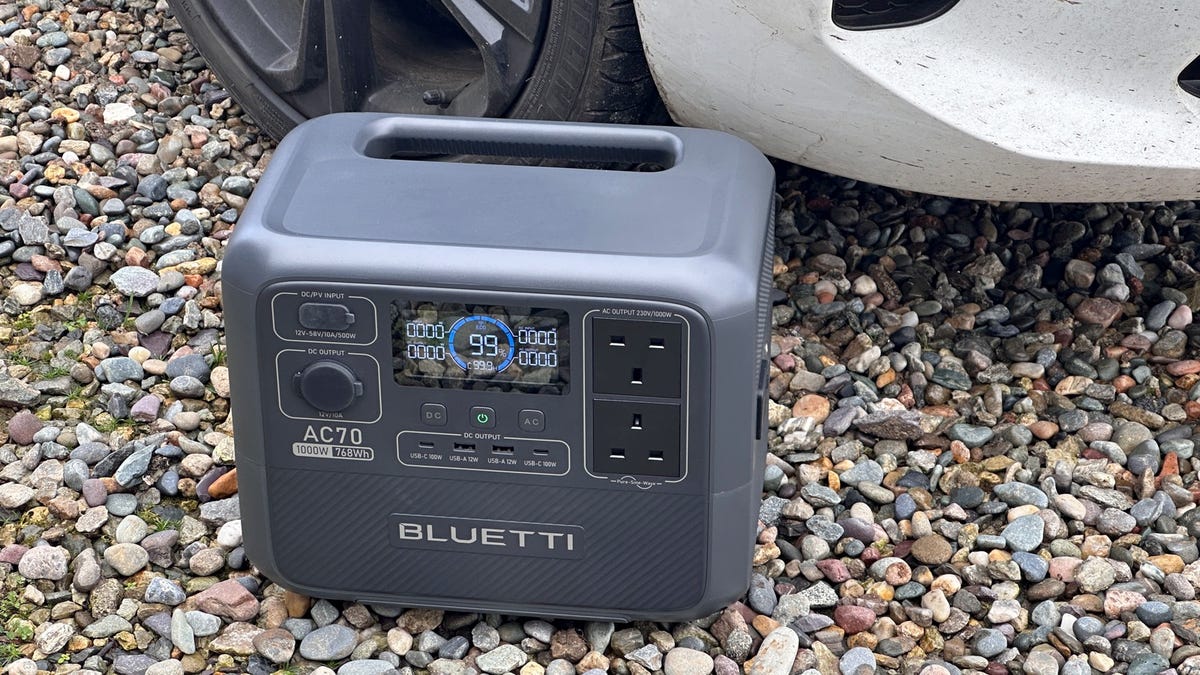
Why we like it: This model from Bluetti is a fantastic budget-friendly option, currently retailing for $359. It’s a powerful unit capable of delivering 1,000W output for regular loads and up to 2,000W for resistive loads like heaters or hair dryers.
I’ve taken this unit with me on many a road trip and it had more than enough energy capacity to meet the needs of a small group for a few days. It can handle charging my smartphone, cameras, drones, and laptops with ease and efficiency.
Review: I tested one of the cheapest portable power stations and it made road-tripping a breeze
Who it’s for: One of its standout features is how quickly it charges, especially with its turbocharging function. In our lab tests, the AC70 charged a device to 80% in just 33 minutes using turbocharging, which is remarkably fast.
Who should look elsewhere: At over 20 pounds, this is starting to edge up there in terms of weight, and not something you’re going to want to move it about much.
Bluetti AC70 tech specs: Capacity: 768Wh | Power: 1000 watts/2000 watts surge | Weight: 22.5 pounds | Connectivity: 7 outlets | Price: $359
Outputs
- 2x AC Output
- 2x USB-A
- 2x USB-C
- 12V Output
Read More
Show Expert Take Show less
Show less
Why we like it: Jackery has been a trusted name in the portable power station industry for over a decade. After testing many of the company’s products, I confidently recommend them.
The Jackery Explorer 500 is an excellent choice for road trips where you need reliable AC power. I love how convenient this unit is. It’s about the size of a basketball and weighs just over 13 pounds, making it easy to carry without straining your back. It can also be conveniently charged from a car’s 12V outlet, adding to its versatility for on-the-go use.
Who it’s for: A fantastically ergonomic unit that lends itself to easy moving about.
Who should look elsewhere: Definitely up there are the pricier of the cheap options, so the budget conscious will need to look elsewhere.
Jackery Explorer 500 tech specs: Capacity: 518Wh | Power: 500 watts/1000 watts surge | Weight: 13.3 pounds | Connectivity: 7 outlets | Price: $329
Outputs
- AC Output
- 3x USB-A
- 2x DC output
- 12V Output
Read More
Show Expert Take Show less
Show less
Why we like it: Anker has been a leader in the power bank market since the early days of portable charging, so it’s no surprise the company also produces high-quality power stations.
If you’re looking for a compact, portable power station to run low-current devices such as laptops, chargers, CPAP machines, the Anker 521 is an excellent choice.
This power station is lightweight, affordable, and built with the durability and reliability Anker is known for. One of its standout features is the ability to recharge via USB-C. This adds a layer of convenience that’s hard to beat. I tend to keep this one for light duties like taking power outdoors during BBQs, but it has come with me on a couple of road trips.
Who it’s for: At under 10 pounds, this one lends itself to being moved about with ease, making it perfect for all members if the family.
Who should look elsewhere: The power output of this unit is at the low end, so it’s limited to the lower-power devices.
Anker 521 tech specs: Capacity: 256Wh | Power: 300 watts/600 watts surge | Weight: 8.2 pounds | Connectivity: 6 outlets | Price: $204
Outputs
- 2x AC Output
- 2x USB-A
- USB-C
- 12V Output
Read More
Show Expert Take Show less
Any of these portable power stations are great options to provide you with power when you need it — it ultimately comes down to the power output you need, how many and which ports you prefer, and what price you’re willing to spend.
|
Choose this cheap portable power station… |
If you want… |
|
EcoFlow River 2 |
A cheap, super-portable power station. This one has everything you need and comes in at $179. |
|
Bluetti Elite 30 V2 |
A cheap, portable power station offering a broad array of ports and a decent power output and weighing under 10 pounds, all for just $220. |
|
Bluetti AC70 |
A big power station available for a low price. If you want a lot of battery capacity, this is the one for you. It costs $359. |
|
Jackery Explorer 500 |
A power station that’s no bigger than a basketball and ideal for road trips. It’s small enough to seatbelt into a spare seat or put in the trunk with the rest of your camping gear. The Jackery comes in at $329. |
|
Anker 521 |
A great power station for those who want to charge their laptop when out and about. It’s small, lightweight, can be charged using USB-C, and is highly portable. The Anker costs $204. |
Show more
Even less expensive power stations are still an investment, both in money and in the physical space they take up, so you need to be sure that you’re buying something that works for you. This means juggling a number of factors.
- Weight: Bigger isn’t always better here. Is the portable power station going to be wheeled from room to room are you going to be moving it from your vehicle to your camp? Do you want something that you cold carry in a backpack for a day?
- Battery capacity: If you plan of powering a home from your power station then you want as much battery capacity as you can afford, but for off-grid adventures it’s important to bear in mind that there’s a penalty here that comes in the form of weight.
- Cost: Some of units cost several thousand dollars, while others are a couple of hundred.
- Charging: How do you plan on charging your power station? Are you mostly going to be using AC power from an outlet or do you want the independence of solar?
- Battery Chemistry: Lithium-ion (Li-ion) is the traditional battery technology, but the newer lithium iron phosphate batteries (LiFePO4) are safer and have a much longer lifespan.
- Warranty: Portable power stations are expensive, so I want manufactures to back their products with multi-year warranties.
- Safety: Every unit I’ve tested has been subjected to numerous tests, from running for extended periods to check thermal management, to overloading them to see how they handle loads that are too much for them.
Show more
At the core of this list is a lot of extensive testing of dozens of power stations. I regularly undertake trips that see me off-grid, either for camping or to carry out photography, videography, and drone work, and at these times, I rely on having access to a reliable power source. This is a great opportunity to test power stations under real-world conditions.
I also test them at home, both using them to run household appliances, and carry out testing on battery capacity, charge and discharge times, and how they handle overloading. Finally, every unit is safety tested to make sure that it is safe for prolonged, heavy use.
Find out more about how we test portable power stations at ZDNET.
Show more
Latest info on cheap portable power stations
January 2026: A few changes this month. New in is the Bluetti Elite 30 V2, a power station that I like a lot, partly because of the fact that it’s under 10 pounds category. and it also comes in a range of colors. Along with the traditional black there’s pink, blue, grey, green, and purple.
After previously being sold out, the Jackery Explorer 500 is also back in the list.
Finally, the links and prices of all existing products were checked to make sure everything is current.
October 2025: As we head from summer to winter, it’s very likely that prices will start to creep up as demand for smaller units increases as people fear blackouts and need a way to power essentials like Wi-Fi routers, phone chargers, and CPAP machines.
Finding a balance between affordability and quality in power stations can be challenging, especially with some models priced significantly above $400. However, setting a budget around the $500 mark is a reasonable starting point for those looking to invest in a portable power station without stretching their finances too thin.
Some of these power stations are brought down below that $400 mark thanks to deals. These sales come and go, so if you’re interested in a particular power station, grab it sooner rather than later.
Show more
Manufacturers typically offer different runtimes for things like lamps, refrigerators, CPAP machines, but if you want to calculate this for yourself you need two figures.
First, you need the power rating of the device you plan on running. This can usually be found on a label on the device and is measured in Watts (W). You also need to know the capacity of the power station measured in Watt hours (Wh). This should also be printed somewhere on the device.
Let’s say you have a device that consumes 300W and a power station that has a capacity of 768Wh, you can get a ballpark runtime for the device using the following equation:
(768 x 0.85)/300 = 2.2 hours
Note that the capacity of the power station is multiplied by 0.85 to account for efficiency losses.
Show more
Four main things separate portable power stations and power banks:
- Capacity: While power banks are perfect for topping up a smartphone or tablet, a power station can be used to charge up devices multiple times because of the vastly bigger battery capacity.
- Size and weight: Power banks are something you can normally slip into a pocket, while power stations are things you lug about or wheel about from room to room.
- Outlets: While power banks feature USB ports, most power stations also have AC outlets for powering powered devices.
- Charging: While power banks are normally charged using a USB charger, power stations can be charged from a number of sources, such as main power, solar, and vehicle 12V outlets.
Show more
Latest Updates:
- October 2025: All links and prices checked to make sure that you’re getting the best possible deals.
Other portable power stations we recommend
Show less
A power station that’s the size of a large Bluetooth speaker, with a handy carry strap, but it still has three AC outlets with 300W (600W surge) outputs.
This is a fantastic, highly portable system for just $250.
Read More
Show Expert Take Show less
Show less
The Jackery Solar Generator 300, a great entry-level solar generator setup.
At the time of publication, this power station is only $199, making it a steal. Whether you want one for camping or as a handy backup in case the power goes out, this is perfect!
Read More
Show Expert Take Show less
For more, check out the best power banks of 2026, how this power bank doubles as a hotspot, and our top home battery and backup systems.